Get Color - Water Sort Puzzle
- 4.8
- Rating
- 50.00M
- Installs
- Free
- Price

 Analysis by App-foxy
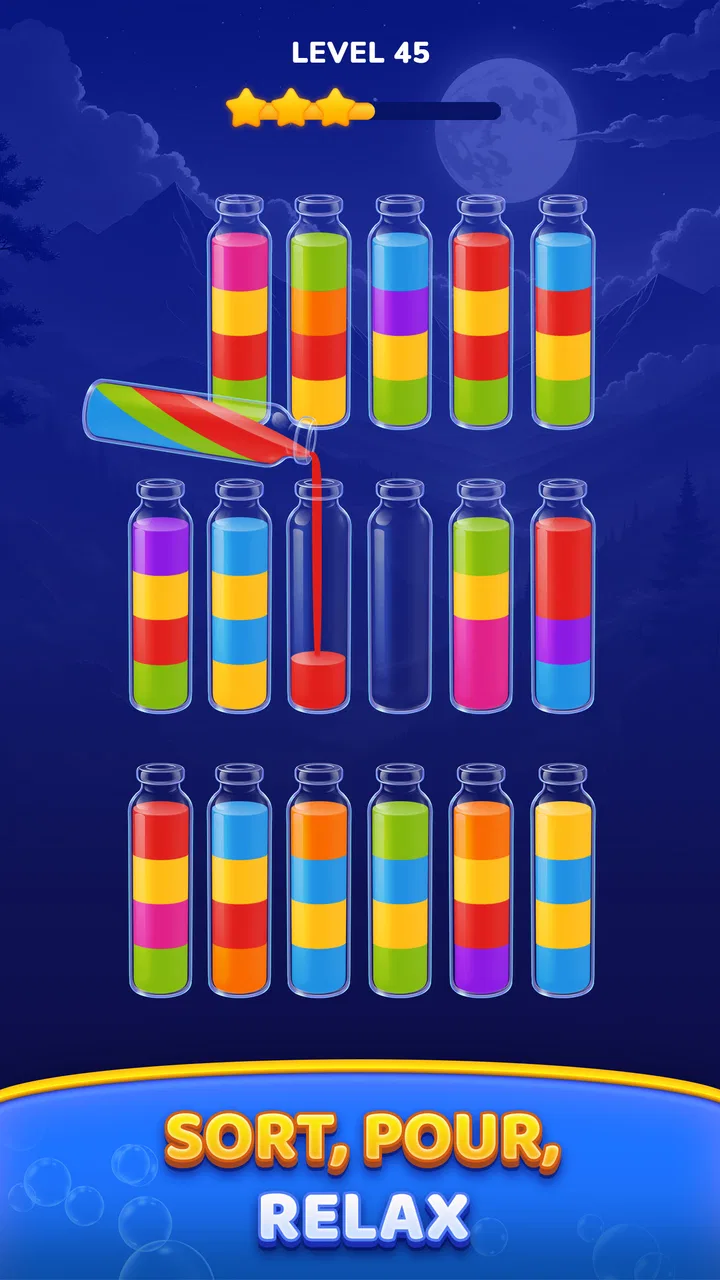
I started Get Color - Water Sort Puzzle expecting a simple way to fill a few spare minutes, and that is exactly where it makes the strongest first impression. The game presents colored liquid in tubes, and my job is to pour it between them until each tube contains a single color. The action is easy to understand immediately: tap one tube, tap another, and watch the layers move if the receiving tube can accept them. That small interaction creates a surprisingly tactile rhythm, because every move produces a visible change rather than merely updating a score.
Developed by Tripledot Studios Limited, this is a free puzzle game for Android users on version 7.0 or later. It is rated for Everyone, so the basic idea is approachable for children, adults, and anyone who prefers calm logic challenges over fast reflexes. Its audience is already substantial, with more than 50 million installs and an average rating of 4.7 from roughly 509 thousand ratings. Those figures do not make it automatically perfect, but they do match my experience: the central mechanic is immediately accessible and easy to return to.
How the color-sorting loop feels in real use
I find the most useful way to judge this loop is to notice whether each pour leaves me with more options, not merely a tidier-looking board. That distinction helps explain why the puzzle can feel thoughtful even when its rules are simple. Next, I’ll look at how its current version and release history frame the experience for someone deciding whether to install it now.
You May Also Like

 Blood Strike: 2.5 Anniversary
Blood Strike’s Loadouts Turn Every Drop Into a Tactical Gamble
A close look at Blood Strike’s custom loadouts: how fast access to signature weapons reshapes its battle royale rhythm, rewards preparation, and narrows the gap between fights.

 Pandora - Music & Podcasts
Pandora’s Music Is Easy to Start, but Harder to Recover
Pandora’s strength is its low-effort path from a seed to a station. Its weak spot is how much confidence it asks you to place in connection, setup, and quiet recovery.

 8 Ball Pool
 Is Built on Rivalries, Rematches, and Routine
A close look at the rivalries, rematches, shared routines, and unanswered safety questions that turn a quick pool match into a persistent mobile community.

 Samsung Music
’s Quiet Strength Is Playing What You Already Own
Its reach comes less from spectacle than from dependable access to a personal library. That simplicity is both the app’s strongest retention engine and its ceiling.

 AccuWeather: Weather Radar
AccuWeather Review: A Quick, Clear Forecast for Everyday Decisions
For everyday plans, the best forecast is the one you can understand quickly. AccuWeather makes rain timing, radar, and local conditions easy to act on, with a few trade-offs.

 Hill Climb Racing
Why Hill Climb Racing Still Turns Crashes Into One More Run
A tiny car, a bumpy hill and one more upgrade: Hill Climb Racing keeps resurfacing because its simple chaos makes every near-miss feel personal.
More From Our News Desk
View All News


The first action is simple, but every pour matters
The opening move rarely feels intimidating. I look at the tubes, identify a color that can be moved safely, and tap the source followed by the destination. The liquid slides across with a clear visual response, and the board changes in a way I can read at a glance. There is no complicated control scheme to learn, which makes the game suitable for a short break when I do not want to spend time studying instructions.
What gives the first action some weight is the limited space. A tube may hold several layers, and pouring is only useful when the destination has room and the top color matches what I am trying to move. That turns a basic tap sequence into a planning problem. I am not just matching colors; I am deciding which temporary arrangement will expose the layer I need next.
My most useful early habit was to avoid moving a color simply because it was available. I first checked whether the move would uncover another color or create a useful empty space. An apparently harmless pour can bury a color beneath a different stack and leave fewer options later. This is one of the game’s quiet strengths: the controls stay casual, while the consequences encourage careful thinking.
The color presentation also makes the board readable without requiring text-heavy instructions. I can understand the state of a tube from its visible layers, and the goal remains consistent throughout a level. That clarity is valuable when playing on a phone in a noisy environment or while waiting somewhere, because I can pause mentally and return to the arrangement without having to remember a complicated rule set.
The feedback rhythm keeps each move understandable
Every successful pour gives immediate feedback. I see the liquid move, the stack become more organized, and sometimes a tube approach completion. That response is important because it connects the decision with the result. In a more abstract puzzle, I might need to wait for a score or a message to know whether I made progress. Here, the board itself tells me.
The rhythm usually follows a satisfying pattern: inspect the colors, make a pour, reveal a new possibility, and reassess the remaining tubes. The game does not demand constant speed, so I can think through a move instead of reacting under pressure. For me, that makes it better suited to winding down than many arcade puzzle games, where the reward comes from surviving a rapid sequence.
There is also a useful difference between a move that looks productive and one that genuinely improves the position. Completing a tube feels rewarding, but creating an empty tube at the right moment can be just as important. I learned to value flexibility over immediate neatness. Leaving several possible destinations open is often safer than finishing one color while blocking the others.
This is where the feedback becomes more than decoration. The visual state acts like a running explanation of my own strategy. If I repeatedly run out of room, the problem is usually not that the controls failed; it is that I committed too early or used a temporary space without considering what would need to pass through it later.
The reward comes from solving the arrangement, not from speed
The strongest reward is the moment a messy group of layers resolves into clean, single-color tubes. It feels like completing a small organizational task. I do not need a complicated story or a large collection system to understand the satisfaction. The board begins visually tangled, and my decisions gradually remove that disorder.
That makes the game a good fit for people who enjoy sorting, organizing, and pattern recognition. I can imagine using it during a commute, before bed, or between household tasks when I want something interactive but not emotionally demanding. A short session can feel complete after one solved arrangement, while a more difficult board can hold my attention longer.
One practical tip is to treat the empty tube as working space rather than as a permanent destination. I often used it to separate a top layer, expose the color underneath, and then move the temporary stack again. This approach is less visually tidy at first, but it gives me more control over the order of later pours. The puzzle becomes easier when I think of the empty space as a tool that must remain available.
Another useful approach is to identify colors that are already close to completion and protect them from unnecessary disturbance. If a tube has a clean sequence that can be finished without blocking another color, I prefer to leave it alone until the surrounding arrangement makes the final move safe. This reduces the number of loose layers I need to track and prevents me from creating extra work for myself.
The reward is not equally strong for everyone. If you need constant novelty, competitive rankings, or a story to motivate each session, the sorting loop may feel too modest. Its pleasure comes from small improvements and successful planning. I found that appealing, but players who prefer action or elaborate progression should probably look toward a different puzzle style.
Why one solved board leads to another session
After a level is resolved, the natural impulse is to begin again because the previous arrangement has been cleared from my mind. The reset matters: I am not simply replaying the same board and trying to improve a time. I am facing a new sorting problem with the same familiar rules, which gives the game a dependable structure without demanding a large learning curve.
This reset-and-retry quality is especially useful in short sessions. I can stop after a completed puzzle without feeling that I have abandoned a long campaign, then return later and begin another board immediately. The game works well as a pocket activity because the commitment stays small. It does not require me to remember a plot, manage a character, or maintain a complicated set of resources between visits.
At the same time, the repeated structure can become predictable. The first few sessions benefit from discovering how much planning the tubes require, but the basic action never changes: choose, pour, observe, and reorganize. I would not recommend it as a sole game for someone who wants a constantly changing set of mechanics. It is better understood as a focused daily puzzle, similar to keeping a small mental exercise available whenever I have a spare moment.
The reset also exposes an important trade-off. Because each new board returns me to the same kind of task, the game is easy to pick up but not necessarily absorbing for long stretches. I usually enjoyed it more when I allowed myself to stop after a natural break instead of forcing a long marathon. That kept the simple loop relaxing rather than turning it into repetitive work.
Where it stands beside other puzzle alternatives
Compared with match-three games, this title is slower and more deliberate. There are no falling pieces demanding immediate reactions; I can examine the entire arrangement before acting. Compared with word puzzles, it relies less on vocabulary and more on spatial planning. Compared with classic number-placement puzzles, it offers a more physical sense of movement because the colored layers visibly travel from one tube to another.
That makes it a particularly good alternative when I want a puzzle that is visually clear but mentally active. It is easier to start than a traditional logic grid, yet it still punishes careless decisions. On the other hand, players who enjoy deep deduction, multiple rule systems, or elaborate level variety may find number puzzles or strategy games more rewarding over time.
The game’s free entry also lowers the barrier to trying it. There are in-app purchases ranging from $0.99 to $119.99 per item, so I would advise checking the purchase flow carefully, especially if the device is shared with children. The age rating is Everyone, which suits the uncomplicated premise, but an age-friendly rating does not remove the need for sensible purchase controls.
For me, the best comparison is not a competitive puzzle app but a small physical sorting activity. The board gives me something orderly to manipulate, and the result is visible after every decision. If I want a calm challenge during a coffee break, this is more appealing than a game that expects constant attention. If I want a dramatic sense of progression or a social contest, I would choose another category instead.
Small strategies that make difficult arrangements less frustrating
I found three habits especially helpful. First, I scan for colors that appear in several tubes and avoid trapping their upper layers too early. A color spread across the board often determines the order of the whole solution, so moving it without a plan can create a chain of awkward repairs.
Second, I use a temporary pour to reveal information, not just to make progress. Sometimes the best move is one that exposes the next layer even though it does not bring a tube closer to completion. This is a subtle shift in thinking: the value of a move can be the information it gives me about the board.
Third, when I reach a dead end, I mentally rewind the last few decisions instead of randomly tapping. A random move may make the tubes look different, but it rarely improves the underlying position. Reviewing where I spent an empty space or split a useful color is more effective and turns a failed attempt into a quick lesson.
These habits also explain why the game can be useful for different age groups. Younger players can practice recognizing colors and sequences, while adults can use the same board as a low-pressure exercise in planning. I would still supervise purchases on a shared device, but the core interaction itself is straightforward enough for the Everyone rating.
Who should play it, and who should skip it
I would recommend it to anyone who likes compact logic games, visual organization, and puzzles that can be paused naturally. It is a strong choice for waiting rooms, short breaks, quiet evenings, or moments when I want to occupy my hands without committing to a long narrative. The controls are approachable, and the challenge comes from arranging the layers rather than memorizing complicated systems.
I would be more cautious about recommending it to players who dislike repetition or who need a strong sense of story. The core loop is intentionally narrow. Its quality depends on whether sorting colored liquid is satisfying to you. If that action feels soothing and the planning feels meaningful, the simplicity becomes a strength. If it feels like busywork after a few boards, additional sessions are unlikely to change your mind.
The current version is 5.29.0, and the game remains free to start. I found that combination convenient for testing the experience without an upfront commitment, but the possible purchase range means I would treat optional spending as a separate decision rather than part of the basic reason to install it. The game earns its place through the puzzle loop, not through the need to buy anything.
My verdict on the action, feedback, reward, and reset
Get Color - Water Sort Puzzle succeeds because its four-part rhythm is easy to feel. I take an action by choosing two tubes, receive immediate visual feedback as the liquid moves, get a clear reward when the arrangement becomes more organized, and then reset into another compact challenge. That sequence gives me a reason to continue without making the game feel demanding.
Its limitations are equally clear. The mechanic is focused, so it may not satisfy anyone looking for broad variety, competition, or a story-driven campaign. The free model includes in-app purchase options, and long sessions can feel repetitive if I do not enjoy the underlying sorting task. Those are not minor details; they determine whether the game fits your habits.
For my use, it works best as a calm, repeatable puzzle rather than an all-purpose mobile game. I like that one careless pour can teach me something, that an empty tube can be used strategically, and that a solved board gives me a clean stopping point. If you want a readable color puzzle that turns a few spare minutes into a small planning exercise, I think it is worth trying. The loop is simple, but the satisfaction comes from making each pour earn its place.
FAQs for Get Color - Water Sort Puzzle
01What is Get Color - Water Sort Puzzle about?
Get Color - Water Sort Puzzle is a fun and engaging puzzle game where players must sort colored liquids into separate bottles. The challenge lies in figuring out the correct sequence to transfer the liquids without mixing colors. It's a game that tests your problem-solving skills and patience.
02Is Get Color - Water Sort Puzzle free to play?
Yes, Get Color - Water Sort Puzzle is free to download and play. However, the app may include optional in-app purchases for hints or to remove ads. These purchases can enhance your gaming experience but are not necessary to complete the game.
03What are the system requirements for Get Color - Water Sort Puzzle?
The game is compatible with most Android and iOS devices. For Android, it typically requires version 4.4 and up, while iOS devices need iOS 9.0 or later. It is advisable to have a stable internet connection for downloads and updates, although the game can be played offline.
04How many levels does Get Color - Water Sort Puzzle have?
Get Color - Water Sort Puzzle features hundreds of levels that progressively increase in difficulty. Each level presents a new challenge, requiring strategy and careful planning to sort the colors correctly. Regular updates often add more levels, keeping the gameplay fresh and engaging.
05Can I play Get Color - Water Sort Puzzle offline?
Yes, Get Color - Water Sort Puzzle can be played offline. This makes it a great option for entertainment on-the-go without needing an internet connection. However, some features, like in-app purchases or updates, will require online access.
Pros
- Intuitive and easy-to-learn gameplay.
- Vibrant and engaging color graphics.
- Challenging levels to keep you hooked.
- Minimal ads for a smoother experience.
- Suitable for all ages
- great family fun.
Cons
- Becomes repetitive after extended play.
- Limited hints can frustrate beginners.
- Ads can interrupt gameplay flow.
- No multiplayer or social features.
- Requires strategic thinking
- not for casuals.

Get Color - Water Sort Puzzle
Gallery